Certificate of Liability Insurance: The Complete Guide
Whether you are requesting COIs from vendors or providing one for your own business, learn exactly what a certificate of liability insurance is, what it covers, what it does not cover, and how to use it to protect your business.
Every commercial relationship that involves physical work, property access, or professional services eventually circles back to the same request: "Please provide a certificate of liability insurance." It is the universal document of commercial trust, one page that tells the other party whether you carry enough insurance to cover the risks you create.
But a certificate of liability insurance is simultaneously one of the most important and most misunderstood documents in commercial risk management. It is not an insurance policy. It does not guarantee coverage. It can be issued in error, outdated the day after it is created, or, in the worst case, entirely fabricated. Yet businesses make million-dollar decisions based on what this single page says.
This guide covers everything about certificates of liability insurance: what they are, what they contain, who needs them, minimum coverage requirements, how to obtain one for your business, how to verify one you receive, and the legal limitations every business owner and risk manager must understand.
What Is a Certificate of Liability Insurance?
A certificate of liability insurance, also called a COI, an ACORD 25 form, or simply a certificate of insurance, is a one-page document issued by an insurance agent or broker that summarizes the key details of a business's liability insurance coverage at a specific point in time. In the United States, it almost always uses the ACORD 25 form, which is the standardized template maintained by the Association for Cooperative Operations Research and Development (ACORD).
The certificate serves as evidence, not a guarantee, that the named insured carries active insurance policies. It answers the basic questions any business partner, client, landlord, or project owner needs answered before letting you onto their property or into their project:
- Who is insured? The legal business name of the policyholder.
- Who is the insurer? The insurance company providing the coverage, along with their NAIC number for verification.
- What types of coverage exist? General liability, auto liability, workers' compensation, umbrella/excess, and any other listed policies.
- What are the coverage limits? Per-occurrence and aggregate limits for each type of coverage.
- When is coverage active? Policy effective dates and expiration dates.
- Who else is protected? Additional insured parties and certificate holders.
The certificate of liability insurance is typically required before a vendor starts work, before a tenant takes occupancy, before an event vendor sets up, or before a subcontractor enters a job site. No COI, no access, this is the standard across property management, construction, facilities, and commercial real estate.
The ACORD 25 Certificate of Liability Insurance Form
In the United States, the ACORD 25 form is the universal standard. When someone asks for a "certificate of liability insurance," they are almost always asking for an ACORD 25. Here is a field-by-field overview of what this form contains:
- Producer (top left). The insurance agent or broker who issued the certificate. Includes agency name, address, phone, and contact information. This is your go-to for verification, call this agent to confirm the certificate is authentic.
- Insured (top center). The legal business name and address of the entity that purchased the insurance. Must exactly match the vendor's legal name.
- Insurers Affording Coverage (top right). Lists each insurance company providing coverage, along with their NAIC number, a unique identifier you can cross-reference on AMBest.com.
- Coverages (middle section). The core of the form. Lists each type of insurance (general liability, automobile liability, umbrella liability, workers' compensation), along with policy numbers, effective dates, expiration dates, and coverage limits per occurrence and aggregate. Each row represents a separate policy.
- Description of Operations (middle-bottom). Free-form text box where the agent notes additional insured status, waiver of subrogation, primary and non-contributory language, and any special provisions or exclusions.
- Certificate Holder (bottom left). The entity requesting the certificate, typically you, the property manager, GC, or client. Being listed here means you receive a copy of the certificate but grants you no rights under the policy.
- Cancellation (bottom center). States that "should" any policy be cancelled, notice will be delivered per policy provisions, but "should" is not a guarantee, and many policies do not require notice to certificate holders.
- Authorized Representative (bottom right). Signature of the agent or broker, certifying that the information on the form is accurate to the best of their knowledge as of the date issued.
Types of Liability Coverage on a Certificate
A standard certificate of liability insurance typically lists four core coverage types. Here is what each covers and what the standard minimum limits are:
Commercial General Liability (CGL)
The foundation of business liability insurance. Covers third-party bodily injury, property damage, and personal/advertising injury claims arising from your business operations. Standard minimum: $1,000,000 per occurrence / $2,000,000 general aggregate. This is the coverage most contractually required for vendors, contractors, and tenants. It protects the certificate holder if your work causes injury or damage on their property.
Automobile Liability
Covers bodily injury and property damage caused by vehicles used in your business, owned, non-owned, and hired autos. Required for any vendor who drives to your property or operates vehicles as part of their work. Standard minimum: $1,000,000 combined single limit. Many organizations overlook this coverage requirement for vendors who use personal vehicles for business purposes.
Umbrella / Excess Liability
Provides additional liability coverage above the limits of the underlying general liability, auto liability, and employers liability policies. It kicks in when underlying policy limits are exhausted. Increasingly standard for construction, high-risk trades, and commercial real estate. Standard minimum: $2,000,000 to $5,000,000. Without umbrella coverage, a serious claim can exceed the underlying policy limits, leaving you or the vendor personally liable for the excess.
Workers' Compensation and Employers Liability
Covers medical expenses and lost wages for employees injured on the job. Required by law in almost every state for businesses with employees. Employers liability, typically $1,000,000 per accident, covers the business if an employee sues for negligence beyond what workers' comp covers. If a vendor's employee is injured on your property, workers' comp should be the exclusive remedy, protecting you from a lawsuit.
Who Needs a Certificate of Liability Insurance?
Two groups of people need to understand certificates of liability insurance: those who request them, and those who provide them.
You Need to Request COIs If You Are:
- A property manager. Every vendor who steps onto your property, landscapers, plumbers, electricians, cleaners, HVAC techs, should provide a COI before starting work. One uninsured vendor incident can cost you tens of thousands in uncovered claims.
- A general contractor. Every subcontractor on your job site should provide a COI naming you as additional insured. If a sub's employee is injured or their work causes damage, their insurance, not yours, should respond.
- A facilities manager. Across an office, industrial, or healthcare portfolio, every service provider needs verified liability insurance on file. Quarterly audits are standard; manual tracking is unsustainable at scale.
- A commercial landlord or CRE owner. Tenants should provide COIs per lease requirements. Vendors servicing the property should provide COIs per management requirements. Both need tracking and verification.
- An event organizer or venue manager. Vendors, exhibitors, caterers, and performers should all provide COIs before the event. A single incident, a foodborne illness, a collapsed booth, a crowd injury, can trigger litigation against the venue.
You Need to Provide a COI If You Are:
- A contractor or subcontractor. GCs and property owners will require your COI before you start work. Without it, you cannot get on the job site. Your insurance agent can issue one in 24-48 hours.
- A service provider. If you perform work at client locations, cleaning, maintenance, IT installation, catering, clients will request your COI as part of vendor onboarding.
- A tenant. Commercial leases almost universally require tenants to provide COIs demonstrating general liability coverage that meets the lease's insurance requirements.
- An event vendor or exhibitor. Event organizers and venues require COIs from all participants. If you sell food, demonstrate products, or set up displays, you will be asked for proof of liability insurance.
Standard Minimum Coverage Requirements
While specific requirements vary by industry, contract, and risk level, here are the standard minimums that most commercial relationships use as a starting point:
| Coverage Type | Standard Minimum | Higher-Risk Minimum |
|---|---|---|
| General Liability | $1M per occurrence / $2M aggregate | $2M per occurrence / $4M aggregate |
| Auto Liability | $1M combined single limit | $1M combined single limit |
| Workers' Compensation | Statutory limits (state-specific) | Statutory limits |
| Employers Liability | $1M per accident | $1M per accident |
| Umbrella / Excess | $2M | $5M |
These are baselines. Construction, roofing, demolition, hazardous materials work, healthcare services, and any trade with high bodily injury or property damage risk should require higher limits. Always consult with your insurance broker and legal counsel when establishing requirements for your specific situation.
Legal Limitations of a Certificate of Liability Insurance
The most important thing to understand about certificates of liability insurance is what they do not do:
- A COI is not an insurance policy. It summarizes coverage; it does not create it. The ACORD 25 form explicitly states it "confers no rights upon the certificate holder." If a claim arises, the policy language, not the certificate, determines coverage.
- A COI is a snapshot in time. It reflects what the agent believed to be true on the date of issuance. The policy could be cancelled the next day, and the certificate gives no indication. This is why ongoing tracking, not one-time collection, is essential.
- A COI can contain errors. Agents make mistakes. Wrong limits, wrong dates, wrong additional insured names, these errors are common and have the same legal effect as accurate information: none. The policy controls, not the certificate.
- A COI does not guarantee cancellation notice. The cancellation clause uses "should", not "shall", and many policies do not require the insurer to notify certificate holders or additional insureds of cancellation. Do not rely on this clause.
- A COI does not make you an additional insured. Being listed as certificate holder gives you zero rights under the policy. Only a formal additional insured endorsement, a separate document, grants you coverage under the vendor's policy.
Understanding these limitations is not academic, it directly affects how you manage vendor compliance. The certificate is a starting point for verification, not the end of it.
How to Get a Certificate of Liability Insurance for Your Business
If you are a business owner who has been asked to provide a certificate of liability insurance, here is the process:
- Have active insurance policies. You cannot get a COI without an active policy. If you do not have business insurance, contact a licensed insurance agent or broker to get coverage in place first.
- Gather the requestor's requirements. Ask the party requesting the COI exactly what they need: minimum coverage limits, whether they need to be named as additional insured, whether waiver of subrogation is required, and whether primary and non-contributory language is needed. Get this in writing, ideally, a copy of the insurance requirements section of your contract.
- Contact your insurance agent. Provide your agent with the certificate holder's full legal name, mailing address, and all requirements from step 2. If the requestor needs to be added as additional insured, your agent will need to issue an endorsement, this may involve a small fee and underwriter approval.
- Review the COI before sending. When your agent sends you the certificate, verify that all information is correct, your business name, the coverage limits, the certificate holder name, and any additional insured or special provisions. Errors here create delays and compliance flags for the recipient.
- Send the COI and endorsement. Provide both the certificate and a copy of any additional insured endorsement to the requestor. Keep copies for your records, you may need to prove you provided timely proof of coverage.
- Set a renewal reminder. Your policy will renew annually (or semi-annually). The requestor will want an updated certificate on renewal. Proactively sending it maintains a professional relationship and avoids last-minute compliance scrambles.
How COI File Simplifies Certificate of Liability Insurance Management
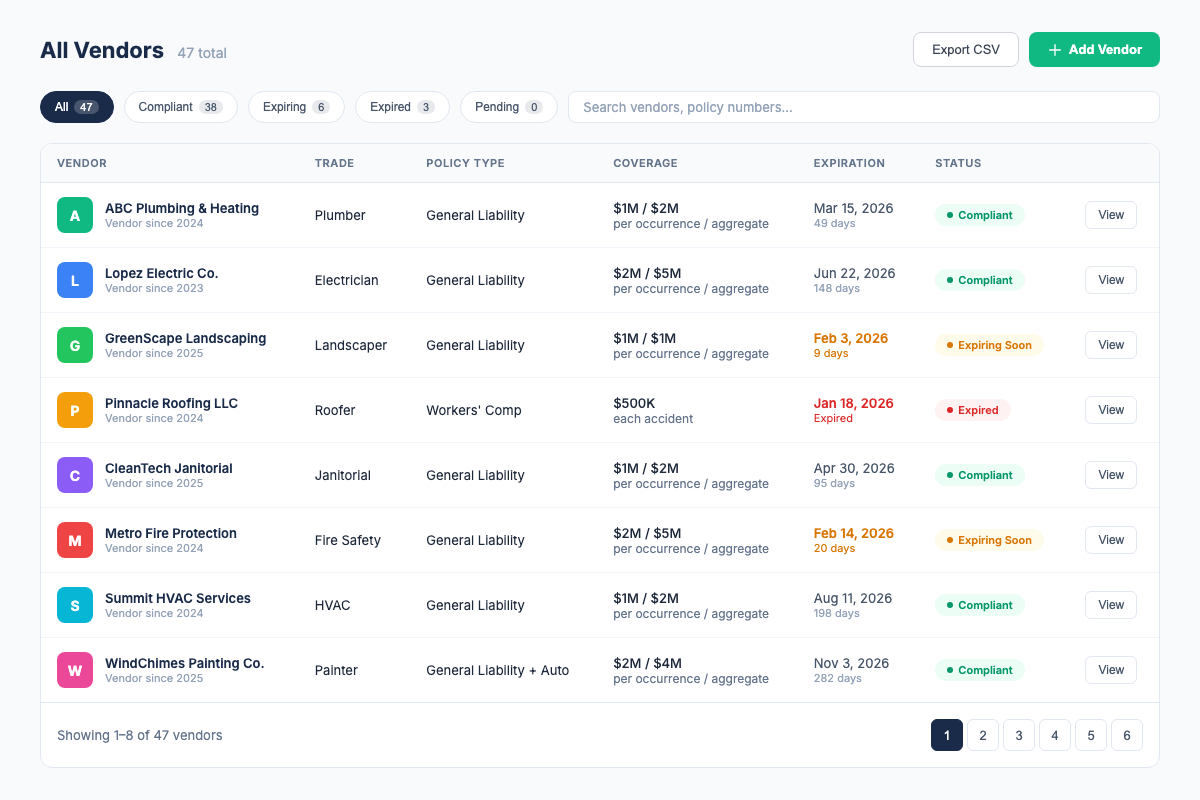
COI File was built to manage the entire certificate of liability insurance lifecycle, from collection through verification to ongoing monitoring. Here is how it works for organizations that need to track vendor COIs:
- Secure certificate collection. Send a vendor a magic link so they can submit an ACORD 25 PDF without creating an account.
- AI-assisted extraction and review. COI File surfaces insurer, policy types, limits, dates, additional insured details, and endorsements for review.
- Automatic expiration monitoring. Alerts run at 30, 14, and 7 days before a vendor certificate expires.
- Vendor follow-up workflow. Use the secure upload link and roster status to reduce email back-and-forth while keeping a human in the approval loop.
- CSV roster export. Export current vendor and status data for internal follow-up or sharing; formal PDF reporting is not a current product promise.
COI File starts with a 7-day trial after secure checkout and payment-method setup. Start a Base trial and stop managing certificates of liability insurance in spreadsheets.
Frequently Asked Questions
Sources & References
- ACORD, Official standards and specifications for the ACORD 25 Certificate of Liability Insurance form. acord.org
- NAIC, State Insurance Requirements, Directory of state insurance departments with licensing and authorization verification tools. naic.org
- IRMI, Certificates of Insurance, Authoritative guidance on COI legal limitations, contractual risk transfer, and certificate management best practices. irmi.com
- A.M. Best, Insurance company financial strength ratings and NAIC number verification. ambest.com
- ISO, Commercial General Liability Forms, Standardized insurance policy forms and coverage language. verisk.com/insurance
Related Resources
- Certificate of Insurance, Complete Guide, everything about COIs, from basics to advanced compliance strategy
- ACORD 25 Form Guide, line-by-line breakdown of every field on the standard COI form
- Additional Insured, Complete Guide, why being a certificate holder is not enough
- How to Verify a COI, 12-point checklist to catch errors and fraud
- COI Requirements by Industry, minimum insurance requirements for every trade and vendor type
- COI File Pricing, transparent pricing, 7-day free trial on all plans
Firdaosh Bano
COI Compliance Specialist
Firdaosh Bano is a COI compliance specialist and the founder of COI File. She spent 6 years managing vendor compliance for commercial properties - tracking 2,000+ COIs across 150+ properties in spreadsheets before building the tool she wished she'd had. She writes about certificate of insurance compliance, vendor risk management, and making insurance tracking less painful for small teams.