COI Tracking for Electricians: Insurance Compliance Guide
Electrical work creates some of the highest liability exposure on any job site. Learn what insurance electricians must carry, how to verify their COIs, and how to track compliance across every project.
Electrical contractors operate in a risk environment unlike any other construction trade. Every job involves working with live circuits, installing complex systems, and making thousands of connections that -- if done incorrectly -- can cause fires, equipment damage, or fatal injuries. The National Fire Protection Association (NFPA) reports that electrical failures and malfunctions are a leading cause of structure fires in the United States, and a significant percentage of those fires trace back to contractor installation errors.
For general contractors and property managers hiring electricians, the insurance verification process is not a formality -- it is a frontline defense against catastrophic liability. A single electrical fire caused by a subcontractor's faulty wiring can generate a $500,000+ claim that falls on the GC and property owner if the electrician's coverage is insufficient or lapsed. This is why COI tracking for electricians requires more rigor than for most other trades.
This guide walks through the insurance requirements every electrician must meet, the specific coverages GCs and property managers need to verify on certificates of insurance, and how COI tracking software eliminates the gaps that put your projects at risk.
Why Electrician COI Tracking Demands Extra Scrutiny
Electricians rank among the highest-liability trades on any construction project for reasons that go beyond the obvious risk of electrocution. Several factors make electrical contractor COIs particularly critical to verify and track:
- Long-tail completed operations risk. An improperly torqued connection, an undersized breaker, or a missed ground fault can lie dormant for years before causing a fire or equipment failure. Completed operations coverage -- not just occurrence coverage -- must be verified on every electrician's COI, because the liability window extends far beyond project completion.
- High workers' comp severity. Electrical injuries are consistently among the most expensive workers' compensation claims in construction. Burns, cardiac events from shocks, and falls from ladders result in claims that can exceed $250,000 per incident. Verifying valid, current workers' comp coverage on every electrician is essential because a single uncovered injury can trigger stop-work orders and OSHA investigations.
- Sub-subcontractor risk. Electrical contractors frequently subcontract portions of their work to specialty electricians -- low-voltage installers, fire alarm technicians, lighting contractors. Each sub-sub requires its own verified COI, and the GC is ultimately responsible if any tier fails to carry proper coverage.
- High-value property exposure. Electricians work inside finished buildings, often around expensive equipment, data centers, and occupied spaces. A single arc flash event can destroy hundreds of thousands of dollars in equipment and cause business interruption losses that no standard liability policy covers unless specifically endorsed.
The Pain Points of Manual COI Tracking for Electrical Contractors
1. Verifying Completed Operations Coverage
Most insurance verification processes check for active general liability -- but miss whether the policy includes completed operations (products-completed operations aggregate). For electricians, this is the single most important coverage verification. A COI that shows $1M/$2M GL but excludes completed operations leaves you exposed to every post-completion claim. Manual reviews frequently overlook this nuance.
2. Sub-Subcontractor Visibility
When an electrical contractor hires a sub-sub (a low-voltage specialist, a fire alarm installer), the GC typically has no direct relationship with that sub-sub -- and therefore no mechanism to receive or verify their COI. The sub-sub shows up on site without the GC ever having seen a certificate. COI tracking software with sub-sub requirements and automated follow-up closes this dangerous gap.
3. Workers' Comp Fraud and Gaps
The electrical trade has a long-documented problem with workers' comp fraud: contractors who purchase a policy, obtain a certificate showing 12 months of coverage, and then cancel the policy after 90 days while continuing to present the original COI. Without periodic reverification and direct state database checks, you could have electricians working on your site with no active workers' comp for nine months of the year.
4. Auto Liability Overlaps
Electricians carry significant materials and equipment in their vehicles -- conduit, wire spools, transformers, panel boards. A vehicle accident involving an electrician's truck can involve both personal injury and expensive cargo damage. Verifying $1M CSL auto liability is important, but many GCs forget to verify it altogether because the focus stays on general liability and workers' comp.
5. Multi-Site Tracking Complexity
Large electrical contractors may work across 10-15 active job sites simultaneously. Each site may have different insurance requirements, and the same electrician's COI might be compliant on one project but non-compliant on another (due to different owner requirements). Without a centralized tracking system, verifying per-project compliance becomes unmanageable.
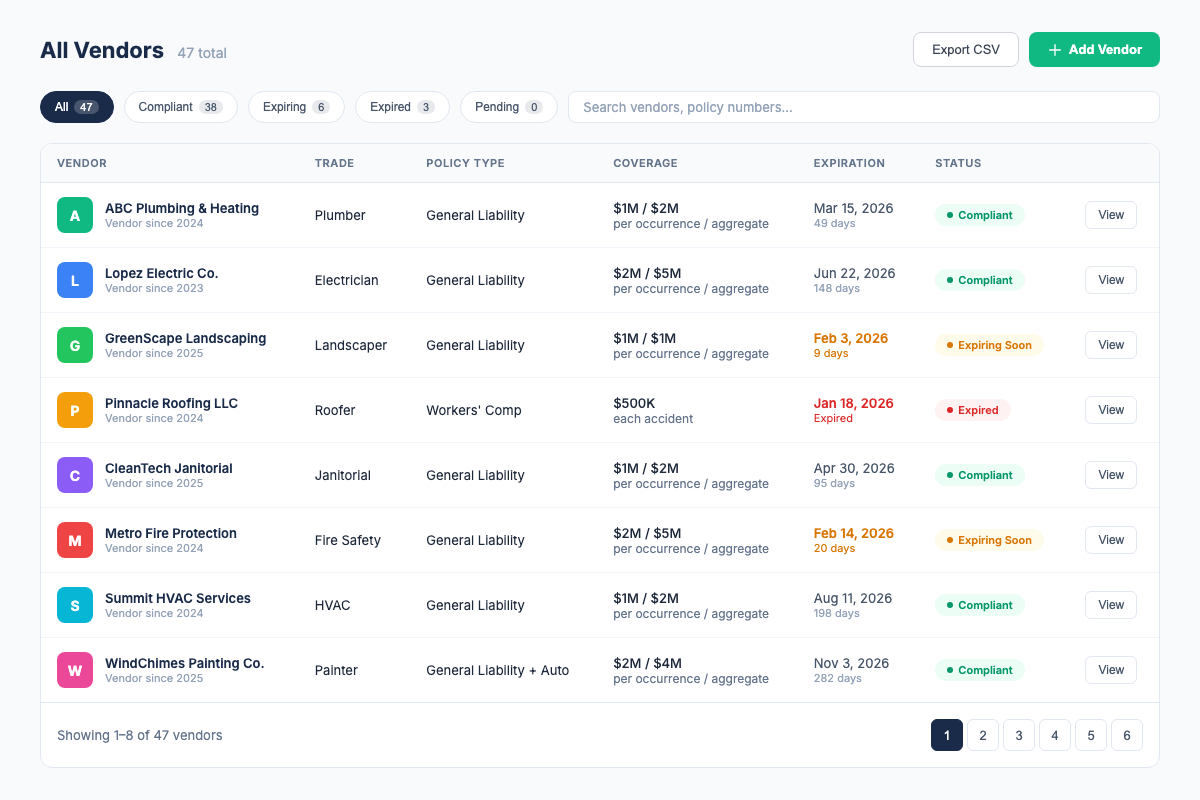
How COI Tracking Software Solves Electrician Compliance
A purpose-built COI tracking platform addresses the unique challenges of managing electrical contractor certificates:
1. Automated Coverage Limit Verification
Define required coverage limits for electricians -- $1M/$2M general liability including completed operations, statutory workers' comp, and $1M CSL auto liability -- and the software automatically checks every uploaded certificate against those thresholds. Non-compliant COIs are flagged immediately, with a clear explanation of what falls short.
2. Sub-Subcontractor Tracking
When an electrical contractor lists sub-subs on their COI or you learn about them through project communications, you can require certificates from those sub-subs directly within the tracking platform. The system sends automatic requests and tracks responses, so no tier of the electrical supply chain operates without verified insurance.
3. Workers' Comp Verification and Renewal Alerts
Beyond checking policy dates on the certificate, the software sends expiration alerts at 30, 14, and 7 days. If a certificate shows an effective date more than 90 days old, the system flags it for reverification -- closing the most common workers' comp fraud window. Integration with state verification databases provides an additional layer of confidence.
4. Per-Project Requirement Matching
An electrician working on a $20,000 residential service call has different insurance requirements than the same electrician working on a $2M commercial buildout. COI tracking software lets you define project-specific requirements and match certificates against them -- so the same electrician's COI can be compliant on one project and flagged as insufficient on another.
5. Audit-Ready Documentation
Every certificate upload, verification, and status change is logged with timestamps. If an electrical fire claim arises 18 months after project completion, you can produce the complete compliance history: when the electrician's COI was received, what coverages were verified, and that completed operations coverage was in force at the time of the work.
What to Look for in Electrician COI Tracking Software
- Completed operations verification. The software must flag whether the products-completed operations aggregate is present and adequate. This is non-negotiable for electricians.
- Customizable requirement templates. You need the ability to define different coverage requirements for different types of electrical work -- residential service calls vs. commercial new construction vs. industrial high-voltage -- because the risk profiles differ dramatically.
- Workers\' comp database integration. The software should offer state-level verification of active workers\' comp policies, not just rely on the certificate dates shown on the COI.
- Sub-subcontractor management. If an electrical contractor lists sub-subs, the platform should allow you to request and track certificates from those entities without creating separate records or workflows.
- AI-powered extraction. Electricians often submit ACORD 25 forms, PDFs, or even smartphone photos of certificates. The software should extract policy types, limits, additional insured status, and dates in under 30 seconds regardless of format.
- Multi-project compliance views. The ability to see a single electrician's compliance status across all active projects, with per-project requirement matching, prevents the "compliant here but not there" problem.
- Automatic expiration alerts. 30/14/7-day alerts sent to both the GC and the electrician. The electrician gets notified to renew; the GC gets notified to follow up if they don\'t.
- Full audit trail. Every action logged with timestamps and user attribution. Essential for defending against claims that arise long after project completion.
COI Tracking Best Practices for Electricians
- Require completed operations on every COI. Never accept an electrician\'s general liability certificate that does not include products-completed operations coverage. This is the most common -- and most costly -- compliance gap in electrical contractor insurance verification.
- Set tiered coverage requirements. Not all electrical work carries the same risk. Define at least two tiers: standard ($1M/$2M GL for residential and light commercial) and high-risk ($2M/$4M GL for industrial, high-voltage, and hospital work). Match each electrician to the appropriate tier based on the scope of work.
- Verify workers\' comp independently. Do not rely solely on the COI. Cross-check workers\' compensation status with your state\'s online verification portal at least quarterly for every active electrical contractor.
- Collect sub-sub COIs at the beginning of every project. Make it a condition of the electrical contractor\'s subcontract that they must provide verified COIs for every sub-sub before those sub-subs begin work. Enforce this through your COI tracking software.
- Require additional insured status with CG 20 10 and CG 20 37. Both endorsements must appear on the certificate. CG 20 10 covers ongoing operations; CG 20 37 covers completed operations. Without both, your entity is unprotected for post-completion claims.
- Monitor auto liability coverage. Electricians carry heavy loads of materials and equipment. Verify $1M CSL auto liability -- and increase the requirement to $2M if the electrician transports hazardous materials (transformers containing oil, large battery banks).
- Reverify mid-project for long-duration contracts. If an electrical project spans more than six months, reverify the electrician\'s COI at the midpoint. Policies get canceled, limits get reduced -- and you need to catch those changes before an incident occurs.
How COI File Helps You Track Electrician COIs
COI File was built by a compliance specialist who spent years managing thousands of trade contractor certificates. Here's how it works for tracking electricians:
- Review an ACORD 25 PDF. Submit an electrician\'s PDF and review AI-assisted surfaced policy types, limits, dates, additional insured details, and endorsements.
- Keep project context. Use property or project tagging and review the requirements that apply to the work.
- Find coverage gaps. Use the review workflow to identify missing or insufficient coverage details and endorsements before approval.
- Use a vendor magic link. Request an updated PDF through a secure link without requiring the electrician to create an account.
- Receive expiration alerts. Automatic email alerts run at 30, 14, and 7 days before a vendor certificate expires.
- Export current status. Download the vendor roster as CSV for internal follow-up or sharing.
COI File starts with a 7-day trial after secure checkout and payment-method setup. Base starts at $39/month for up to 10 vendors. Start a Base trial.
Frequently Asked Questions
Industry Sources
- National Fire Protection Association (NFPA) -- NFPA 70 (National Electrical Code) standards, electrical fire statistics, and safety guidelines for electrical contractors. nfpa.org
- National Electrical Contractors Association (NECA) -- Industry standards, safety programs, and insurance guidance for electrical contractors. necanet.org
- Occupational Safety and Health Administration (OSHA) -- Electrical safety standards, injury reporting data, and compliance resources for construction. osha.gov/electrical
Related Resources
- COI Tracking: The Complete Guide -- the full pillar page covering all aspects of COI tracking
- COI Tracking for General Contractors -- how GCs manage subcontractor compliance across trades
- COI Tracking for HVAC Contractors -- insurance requirements for HVAC and mechanical contractors
- COI Tracking for Commercial Real Estate -- tenant and vendor compliance for property managers
- Best COI Tracking Software -- compare features, pricing, and which tool fits your needs
- COI File Features -- see everything our platform does
Firdaosh Bano
COI Compliance Specialist
Firdaosh Bano is a COI compliance specialist and the founder of COI File. She spent 6 years managing vendor compliance for commercial properties - tracking 2,000+ COIs across 150+ properties in spreadsheets before building the tool she wished she'd had. She writes about certificate of insurance compliance, vendor risk management, and making insurance tracking less painful for small teams.